Tuesday, 13 January 2015

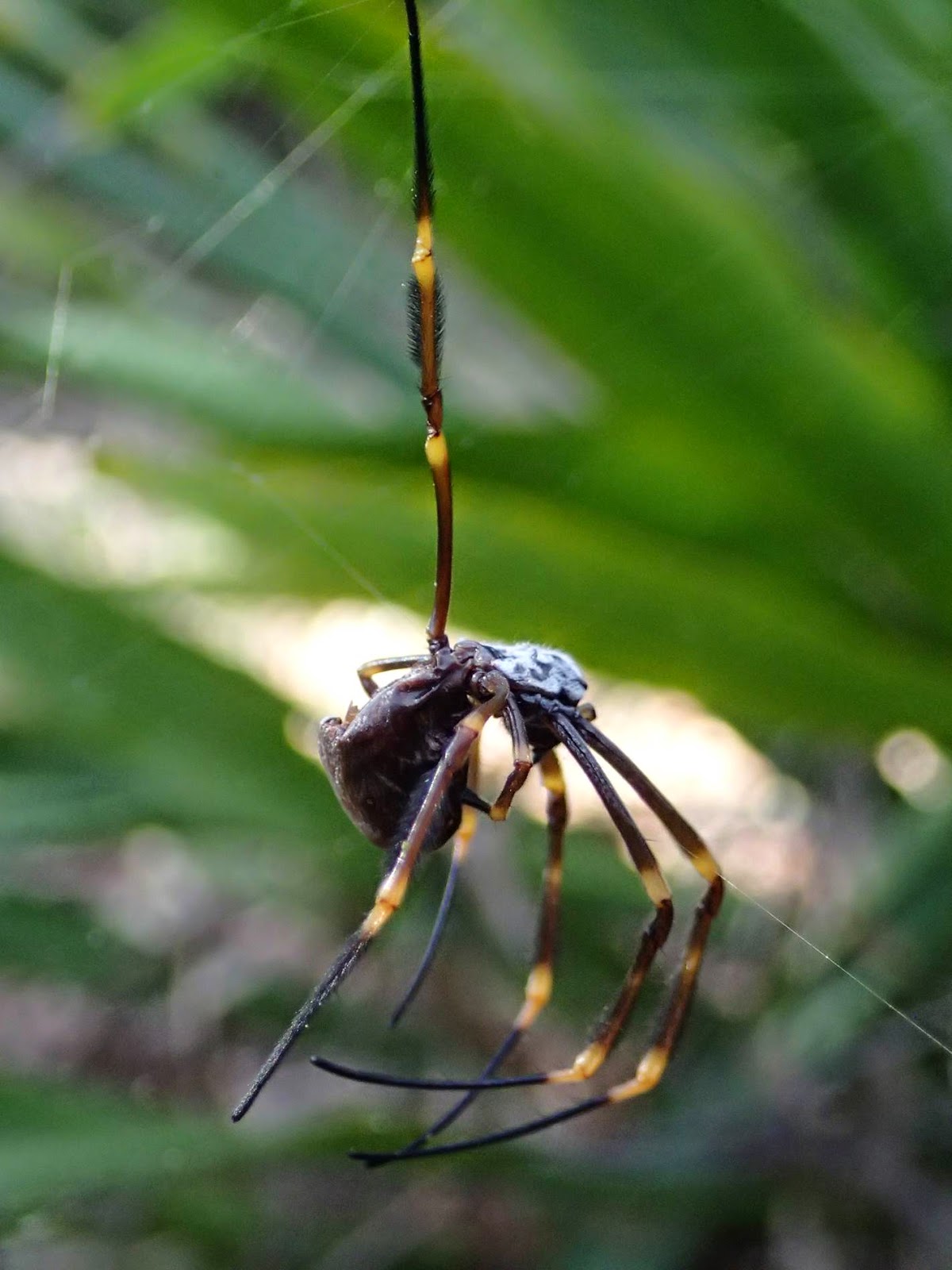
It's Nephila season!

I’m in the thick of thesis writing at the moment so this blog has been a bit neglected, but it’s the time of year when all my spiders are out in force so I thought I’d write a little (more) about them.

Here is a juvenile from outside my building at the University of Sydney
(my hand is there because it's easier to take a photo on my phone with something in the background!)

As my previous post mentioned they lay these beautiful yellow egg sacs towards the end of their lifespans from May- July. The females then die off (the males are already gone, they are only around at the beginning of the season) and the eggs remain dormant till around November.

Then at the end of the year the spiderlings will hatch out but stay within the egg sac for the first couple of molts (around 3 weeks). See this page for more info on why spiders molt. In November/December they emerge as tiny little spiders that look nothing like the adults (they have a lot of growing to do).

One of the egg sacs that hatched in the lab, 100's of spiderlings!

They will live in a little group like this for a few weeks before venturing out to make their own webs.

By the time the new year comes around you'll start noticing Nephila of all sizes, often in aggregations which include multiple developmental stages.

In January/February you will also start to see the little red males sitting in the females web. Even if the female is not mature yet, they will sit around and wait for her last few molts (once they stop molting they have reached maturity).

The numbers of Nephila fluctuate drastically from year to year. In the first year of my PhD (2012) I was inundated with large females everywhere I looked (including on campus at USYD) but in 2013 there was a heat wave in NSW and my counts went from over 200 spiders at one site to less than 4.

I have been monitoring the numbers and developmental stages of Nephila from around Sydney for three years now, and I hope that this data will shed some light on the factors affecting their fluctuating populations. 

You can help me with this research by taking a photo of any Nephila you find and uploading it to my project on inaturalist (either on your computer or through the app). www.inaturalist.org/projects/golden-orb-weavers-nephila-plumipes-in-sydney

If you would like any more info or need some help with the inaturalist site just pop me an email at elizabeth.lowe@sydney.edu.au

Happy spider hunting!


Tuesday, 2 September 2014

Why all PhD's should do a 3 minute thesis

I competed in the 3 minute thesis (3MT) competition recently and it was such a great experience that I thought I would share it here.

Sitting down and trying to summarise 3 years of work into 3 mins is a very hard task, especially when trying to make it accessible to a general audience. It really makes you take a step back and remember what's important about your work. Why SHOULD people care about what I do and find it interesting?

I know this has all been said before but it is so vital to be able to explain your research quickly and accessibly. I think this experience will not only help me tell my Grandma what I do, but will be a huge advantage when I want to explain my research to future collaborators or employers.

The 3MT experience was especially useful for me because I had a fair amount of media exposure a few weeks ago as a result of a paper I published. I had so many radio interviews and my first stint on live TV which was petrifying. But whenever my brain froze on a difficult (or completely normal) question, little snippets of my 3MT came back to me and mercifully gave me something intelligent to say.

I also learned that I have to stop putting my hands in my pockets when I give presentations.

So here is what I said, and why I think my research is important!

Photo by Glenda Wardle @desert_ecology
We live in a world that has changed drastically in the last 100.
Urbanisation creates novel environments with completely different conditions to those in which most animals evolved to survive in.
As a result, the majority of animals are driven to extinction in human inhabited areas.
But there are some animals, called urban exploiters, which can  survive and even thrive in cities.
Those of us living in cities see urban exploiters such as pigeons and crows every day.
But did you know that these urban dwellers may be showing physical and behavioural changes as a result of these novel environments?
For example there are birds which have changed the pitch of their calls or the time of year that they lay their eggs. Some have even completely stopped migrating.
My research looks at the effect of urbanisation on wildlife, and to do this, I study spiders.
They might seem like an odd choice but spiders are the perfect model organism for this research.
They are an important component ecosystems through their predation on flies and other pest species and are food resources for birds.
Also, they are very diverse, and some, but not all, do particularly well in cities
The first step of my research was to find out which spiders are living in cities.
Imagine your back garden, how many different types of spider do you think live in there? Maybe some huntsmen and a red back?
I found an average of 13 species, and up to 20 in some gardens.
Quite amazing biodiversity, all of these spiders here are regulars in Sydney back gardens.
Although there were some spiders that were only found in natural areas, we see there are many species that like cities.
To find out why, I focused on these beautiful golden orb weavers which are common in the Sydney area.
I found that not only are there more of them closer to the city, but they are larger and have increased reproductive capacity in urban areas.
They did particularly well in areas with lots of concrete surfaces and manmade objects
So this is an example of how some species can benefit from urbanisation.
I also looked at whether spiders, like birds, are altering their behaviors in urban areas.
I found that spiders cities respond to stimulus differently to rural spiders. They are less bold and less active.
This is evidence that some spiders are altering the way they behave in order to survive in cities.
Through my research, and the work done by other urban ecologists, we are gaining a better understanding of the impacts of urbanisation on wildlife.
We can use this knowledge to maintain biodiversity in cities, and create healthy, functioning ecosystems in urban areas.

Usyd 3MT finalists. Photo from The University of Sydney FB page


Tuesday, 19 August 2014

So many amazing spiders

It's been a very busy couple of months, but I'm almost finished classifying all my spiders. With over 5000 individuals it's been a difficult but exciting process.

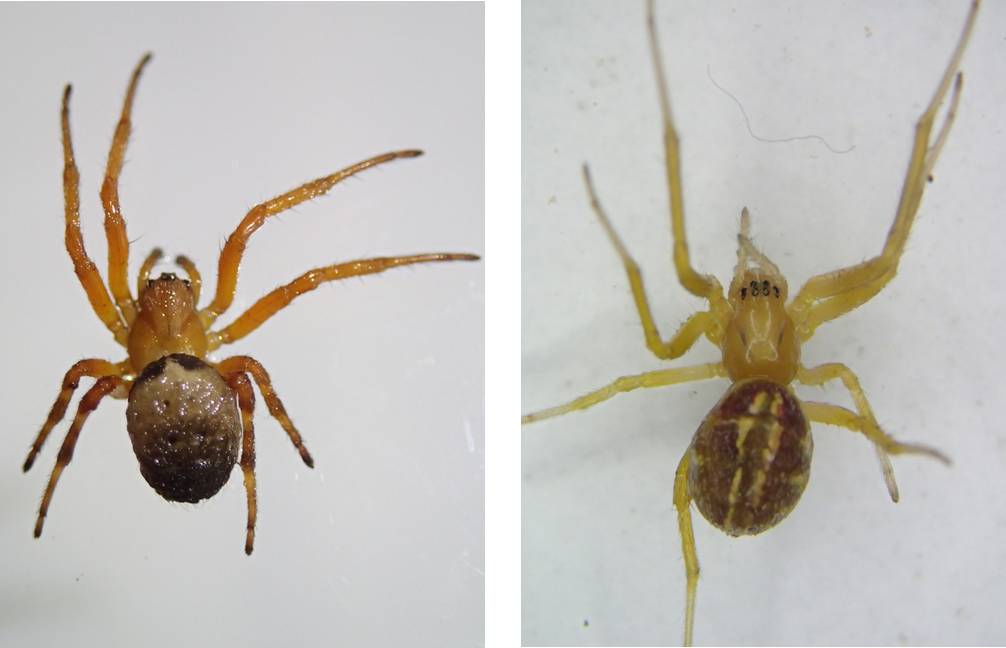
I will try to share some more of what I've learnt over the next few months but for now, here is a sneak preview of some of the amazing diversity I've found in Sydney backyards.


Wednesday, 11 June 2014

Observations of Golden Orb Weavers


It’s getting pretty cold Sydney in the moment, which means that most orb weaving spiders are coming towards the end of their season and I finally have some time to reconcile the work I’ve been doing for the last few months.

Some of the Golden Orb Weaving spiders I released for my transplant experiment are still around so I thought I would share some of my (mostly unexplained) observations and questions about these spiders.

Observation 1) How do they die?

We’re really not sure what eats golden orb weavers. They are very conspicuous with their fat bodies and their big webs out in the open, so why don’t they get eaten more often? Maybe they are just not tasty or  it could be that their strong 3D web structure is enough to deter most birds (for reasons obvious in the photo below from the telegraph news paper). 


Birds must eat some of them because I’ve noticed many of my spiders missing with a large hole in the middle of the web. Also, while I was out releasing my spiders I got to experience a rare predation event first hand as a Kookaburra swooped down in front of me and gobbled one up. So I guess they are tasty!

I also found one very dead looking spider in her web next to a dead bee. The spider must have been a bit too slow in wrapping up her prey and got stung by the bee. Interestingly the next week I went back and the spider was sluggish but alive. She lasted a few more weeks.

Parasitism is probably also a large player. I found this spider dead in the web with a hole in her abdomen:

And I've seen a number of spiders parasitised during my trips out in the field, I felt really sorry for this little garden spider!


Observation 2) Reproduction

I placed some of my spiders out in the middle of national parks to see if they survived longer than the ones in the city. I didn’t see any other golden orb weavers in these locations and yet 3 weeks into the trial a male turns up on one of the females webs. There is no way he could have come in with the female so I guess he was just out there waiting and got very lucky…? There must be lots of disappointed males out there.


I’ve also seen many females make egg sacks this year, which is a relief because many didn’t survive long enough to breed last year (it was a very hot summer). On many occasions the spider will die after she has created her egg sac, and those that don’t die often move webs. I’m not sure why they would do this, they only move ~5m and I would have thought it easier to go back to their original web. 

Observation 3) Web building and... swapping?

Some of the spiders I released started making their webs straight away, by dropping down on a long thread and drifting to another branch. Almost all of the spiders I found had made their webs after the first week. But one spider, still tagged, showed up over 2 months after I had released her, in a web right next to her release spot. So she must have been sitting around for weeks, with no way to catch food... I wonder what she was waiting for.

I’ve also noticed a few occasions when spiders will swap webs. I’ve never witnessed conflict between two spiders because they usually stay in their own web but maybe the bigger one decides she wants the web of the smaller one sometimes. This also makes it quite hard to keep track of who is who, lucky most of my bee tags stayed on!

Thursday, 20 March 2014

Bee tags on spiders!

I've just started what I hope will be the one of the last experiments for my PhD, which involves collecting Golden Orb Weavers and transplanting them to new sites.

I went out to La Perouse this morning to collect a few mature females for my pilot study. There is a great colony of them out there, right next to the road so it's a perfect field site (it's also a great dive spot, which is how I originally found it!).

In order to make sure that I'm looking at the same spiders once I transplant them I need to be able to identify them. So I've decided to use bee tags! Finally a skill from my honors work that I can use for my PhD (I did my honors in Perth with the CIBER bee lab).


Bee tags are very small plastic disks which are glued onto the abdomen of queen bees so that the apiarists can make sure that the queen is the original one they placed in the hive (some times hives will kill the queen and make their own).

I was worried that the spiders would be very mobile, so for the first one I put her in the fridge for 5 min to slow her down a little. This worked well, so for the next one I decided to be really brave and try the process on an "awake" spider (keeping in mind that they are very large and can move quite quickly!). Thankfully this turned out to be no problem, they were all very well behaved!
Spider now known as Yellow #1
 So now that my 5 test spiders have been marked, they will be kept in the lab over the weekend and I will release them next week. 

I would like to release them on campus so I can keep an eye on them but there are 3rd year students doing invertebrate collections at the moment so I'm not sure they would be safe...


Wednesday, 19 March 2014

Missed opportunity for a "Cyclops spider"

Now this is a weird one; Family Oecobiidae Genus: Oecobius


They are very odd looking with their small bunch of eyes and flat round head.

The common names for this family are Disk web weavers or Flat-mesh weavers, both pretty boring
as far as common names go. No one ever thought to call them Cyclops spiders? I would have.

Apparently Oecobiidae meaning means "those who are house-living", still boring but it makes sense I guess!

Apparently they are quite common and live in cities (my specialty!) but I've only ever found the one, in a tiny garden in Marrcikville. I was pretty stumped when I did find it! but  I did a quick search on arachne.org.au and worked it out (such a great website!).

Wikipedia tells me that they eat ants and that a "characteristic of the family is the anal gland; it bears a tuft of long hairs" but gives no indication of the function of these hairs...? Ah if only I had more time (and never ending research funding).

Anyway, apart from that I know next to nothing about these little guys, but I'm going to keep an eye out for them. I think most of the info on them comes from the US or Europe so it would be interesting to see if they have the same affinity to urban areas in Australia.


Thursday, 27 February 2014

Scorpion tailed spiders and leaf curlers

I love scorpions, and you may have already worked out that I have a soft spot for spiders, so these guys are definitely favorites.


Scorpion tailed spiders (genus Arachnura) are one of those great taxa where the name says it all. They come from one of the most common families of spider, the Araneidae which includes a few of the spiders I have mentioned in previous posts; the St Andrews cross spiders, and the garden and golden orb weavers.

The "tail" is a very elongated abdomen, which looks quite like a scorpion when arched up (but without the sting!). They use their "tail" as a disguise by sitting in the center of the web, tail up and pretending to be a leaf. As always, there are some great photos of them at www.arachne.org.au

I once when collected a scorpion tailed spider from a web, I was so sure that it was a leaf until it moved at the last second. I have found quite a few of these in urban Sydney, so keep an eye out if you're in Eastern Australia!

Scorpion tailed spiders often place debris around themselves to complete the leaf illusion. Most orb weaving spiders will clear our any non edible objects that fall into the web, but a few collect debris and use it to hide in. Another great example of this is the leaf curling spiders that you see every where in Sydney at the moment. These are also in the family Araneidae and there are two main species, one from the Genus Araneus (left) and the other from Phonognatha (right).


They usually collect a leaf and wrap it around themselves as protection. I took this photo to show the effect of urbanisation on spiders, the leaf curing spider has curled itself up in some styrofoam packaging!


Wednesday, 19 February 2014

Venomless spiders

During my searches I have often seen lots of webs with many small black spiders, all within the same web. But it wasn't until I collected some and put them under the microscope that I identified them as belonging to the family Uloboridae, commonly called Venomless spiders.

Before I began my survey work I hadn't even heard of venomless spiders!


Seeing as most spiders rely on their venom to subdue their prey this made me wonder how these guys manage to catch anything. Apparently they crush their prey with many layers of silk. I wonder why any spider would evolve away from using venom when it seems to work so well? My first guess is that venom is probably very metabolically expensive to produce. So by not producing venom they actually have to eat less prey.

Also, these little spiders are often social (another rare trait for spiders), living together in multiple webs. Maybe this social interaction allows them to catch prey without venom, or maybe the lack of venom allowed them to become social (ie. they couldn't attack each other anymore!).

They are very common in Sydney, and sometimes there are many hundreds of them in one garden, but they are often overlooked. In fact, even most of the published papers about this family are from the 50's and 60's, maybe it's time for another look!

I'm pretty sure that I have only found one species so far, but there is so much colour variation that it's hard to tell.


Tuesday, 11 February 2014

More cool crab spiders

It's been a little quiet on my blog scene for the last few weeks. It's field work season (yay!) so I'm spending my time out searching for my golden orb weavers and writing up a paper (stay tuned!).

Even though I'm not currently sorting my samples, I wanted to share some more cool little spiders I found a few weeks ago.

I have posted about crab spiders before (don't you think it looks like a Persian rug?) and they are quickly becoming my 3rd favorite family/group of spiders (1st has to be my study species, Nephila and 2nd goes to jumping spiders).

So here are a few more crab spiders which have really amazed me.

First, a tiny little spider from the genus Bominae (that is the head of a pin!)

Now for a closer look, see how the abdomen is like a concertina? I'm guessing this is so that the abdomen can expand when the spider is gravid. I've never seen it in larger spiders so maybe it's a consequence of being very small?

See some much better photos here.

And just quickly, two other species that caught my eye from the Genus Sidymella.

The long arms on these species are used to catch prey as they sit out on the end of leaves or branches. I don't know what the protrusions on the first species abdomen are for, but the second was very cleverly disguising itself as a twig when I found it.

Sometimes I feel a little bad collecting them when they have tried so hard to remain unseen, but it also makes me wonder about all the camouflaged spiders out there that I'm not finding!

Tuesday, 4 February 2014

Is this spider male or female?

I promised a while ago to explain how to tell the difference between male and female spiders. It's one of the most common questions I get asked, especially by kids when I point out a mummy or daddy spider!
On a side note, I met so many kids during my garden surveys that were fascinated by the spiders we were finding, and asking really great questions too! It really made my day. If these kids keep on asking questions like this about everything they see around them they're going to make great scientists one day.

Anyway back to sexing spiders...hmmm...

Firstly, as you might know, most females spiders are larger than the males. This is called sexual dimorphism and it is a result of smaller males having an evolutionary advantage (ie. they are able to sneak in and mate with the female, or avoid being eaten by her afterwards!).

Here is a photo I took of a very large female of my study species Nephila plumipes. Can you see the tiny little male on the left?


But sometimes the males of this species are also quite large (comparatively). The photo below is a male (right) with an immature female. This large variation in the sizes of males can happen (in an evolutionary sense) when males have an advantage if they are EITHER large (ie. more likely to out compete a smaller male) or very small.


In some species the males are always the same size, or even larger than the females. This photo shows a pair or Garden orb weavers (Family Araneidae, Genus: Eriophora)


The one on the left is the female and the right is the male. The way I can tell is by looking at the palps, the appendages near the mouthparts. The male has large palps with bulbous ends, he uses these to deposit sperm into the female. In comparison the female has long thin palps. 


Females also have a genital opening called the epigynum near the book lungs on the underside of the abdomen (although this is harder to see). In some Araneidae species there is an interesting protrusion from the epigynum, I'm not sure what this is for. This photo comes from the Cross spiders I was studying in Germany, more on that later.