Thursday, 27 February 2014

Scorpion tailed spiders and leaf curlers

I love scorpions, and you may have already worked out that I have a soft spot for spiders, so these guys are definitely favorites.


Scorpion tailed spiders (genus Arachnura) are one of those great taxa where the name says it all. They come from one of the most common families of spider, the Araneidae which includes a few of the spiders I have mentioned in previous posts; the St Andrews cross spiders, and the garden and golden orb weavers.

The "tail" is a very elongated abdomen, which looks quite like a scorpion when arched up (but without the sting!). They use their "tail" as a disguise by sitting in the center of the web, tail up and pretending to be a leaf. As always, there are some great photos of them at www.arachne.org.au

I once when collected a scorpion tailed spider from a web, I was so sure that it was a leaf until it moved at the last second. I have found quite a few of these in urban Sydney, so keep an eye out if you're in Eastern Australia!

Scorpion tailed spiders often place debris around themselves to complete the leaf illusion. Most orb weaving spiders will clear our any non edible objects that fall into the web, but a few collect debris and use it to hide in. Another great example of this is the leaf curling spiders that you see every where in Sydney at the moment. These are also in the family Araneidae and there are two main species, one from the Genus Araneus (left) and the other from Phonognatha (right).
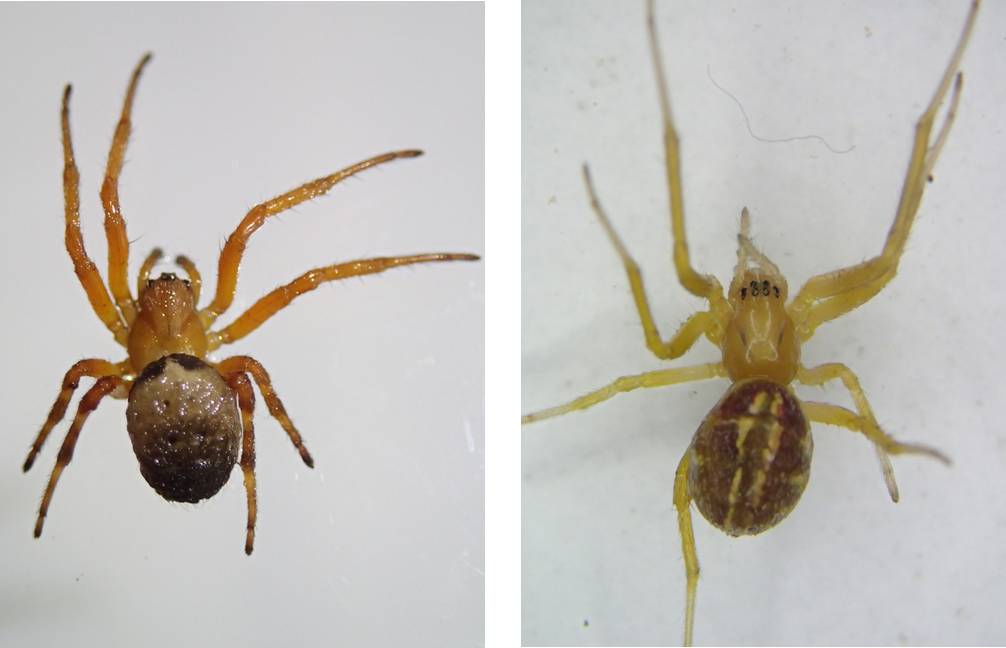

They usually collect a leaf and wrap it around themselves as protection. I took this photo to show the effect of urbanisation on spiders, the leaf curing spider has curled itself up in some styrofoam packaging!


Wednesday, 19 February 2014

Venomless spiders

During my searches I have often seen lots of webs with many small black spiders, all within the same web. But it wasn't until I collected some and put them under the microscope that I identified them as belonging to the family Uloboridae, commonly called Venomless spiders.

Before I began my survey work I hadn't even heard of venomless spiders!


Seeing as most spiders rely on their venom to subdue their prey this made me wonder how these guys manage to catch anything. Apparently they crush their prey with many layers of silk. I wonder why any spider would evolve away from using venom when it seems to work so well? My first guess is that venom is probably very metabolically expensive to produce. So by not producing venom they actually have to eat less prey.

Also, these little spiders are often social (another rare trait for spiders), living together in multiple webs. Maybe this social interaction allows them to catch prey without venom, or maybe the lack of venom allowed them to become social (ie. they couldn't attack each other anymore!).

They are very common in Sydney, and sometimes there are many hundreds of them in one garden, but they are often overlooked. In fact, even most of the published papers about this family are from the 50's and 60's, maybe it's time for another look!

I'm pretty sure that I have only found one species so far, but there is so much colour variation that it's hard to tell.


Tuesday, 11 February 2014

More cool crab spiders

It's been a little quiet on my blog scene for the last few weeks. It's field work season (yay!) so I'm spending my time out searching for my golden orb weavers and writing up a paper (stay tuned!).

Even though I'm not currently sorting my samples, I wanted to share some more cool little spiders I found a few weeks ago.

I have posted about crab spiders before (don't you think it looks like a Persian rug?) and they are quickly becoming my 3rd favorite family/group of spiders (1st has to be my study species, Nephila and 2nd goes to jumping spiders).

So here are a few more crab spiders which have really amazed me.

First, a tiny little spider from the genus Bominae (that is the head of a pin!)

Now for a closer look, see how the abdomen is like a concertina? I'm guessing this is so that the abdomen can expand when the spider is gravid. I've never seen it in larger spiders so maybe it's a consequence of being very small?

See some much better photos here.

And just quickly, two other species that caught my eye from the Genus Sidymella.

The long arms on these species are used to catch prey as they sit out on the end of leaves or branches. I don't know what the protrusions on the first species abdomen are for, but the second was very cleverly disguising itself as a twig when I found it.

Sometimes I feel a little bad collecting them when they have tried so hard to remain unseen, but it also makes me wonder about all the camouflaged spiders out there that I'm not finding!

Tuesday, 4 February 2014

Is this spider male or female?

I promised a while ago to explain how to tell the difference between male and female spiders. It's one of the most common questions I get asked, especially by kids when I point out a mummy or daddy spider!
On a side note, I met so many kids during my garden surveys that were fascinated by the spiders we were finding, and asking really great questions too! It really made my day. If these kids keep on asking questions like this about everything they see around them they're going to make great scientists one day.

Anyway back to sexing spiders...hmmm...

Firstly, as you might know, most females spiders are larger than the males. This is called sexual dimorphism and it is a result of smaller males having an evolutionary advantage (ie. they are able to sneak in and mate with the female, or avoid being eaten by her afterwards!).

Here is a photo I took of a very large female of my study species Nephila plumipes. Can you see the tiny little male on the left?


But sometimes the males of this species are also quite large (comparatively). The photo below is a male (right) with an immature female. This large variation in the sizes of males can happen (in an evolutionary sense) when males have an advantage if they are EITHER large (ie. more likely to out compete a smaller male) or very small.


In some species the males are always the same size, or even larger than the females. This photo shows a pair or Garden orb weavers (Family Araneidae, Genus: Eriophora)


The one on the left is the female and the right is the male. The way I can tell is by looking at the palps, the appendages near the mouthparts. The male has large palps with bulbous ends, he uses these to deposit sperm into the female. In comparison the female has long thin palps. 


Females also have a genital opening called the epigynum near the book lungs on the underside of the abdomen (although this is harder to see). In some Araneidae species there is an interesting protrusion from the epigynum, I'm not sure what this is for. This photo comes from the Cross spiders I was studying in Germany, more on that later.

Thursday, 30 January 2014

Lynx spiders

Lynx spiders come from the family Oxyopidae. As my supervisor likes to say, they are like a cross between jumping spiders and wolf spiders. As you can imagine this makes them very hard to catch!

They don't build a web to catch prey so they have good eye sight (like jumping spiders) for catching insects on the run.
Oxyopidae
Oxyopidae
Oxyopidae
Oxyopidae
Oxyopidae

One of their most obvious features are the spikes on their legs, but they also can have very pretty stripe patterns (which I never realised until I got them under the microscope!)

Here are the four species I've found so far:

Monday, 27 January 2014

Theridiidae

Theridiidae is a very large family of spiders (Wikipedia tells me there are over 2200 species). One famous example is the Hawiian happy face spider, which is cute AND has an interesting evolutionary history (it is only found in certain locations along the Hawaiian chain of islands).

The most obvious Theridiid species from Australia is Latrodectus hasseltii, the Redback spider. Interestingly, I have only ever seen Redbacks on man-made objects, never on plants or in bushland. This really makes me wonder what their native habitat is!

There are also many other Theridiid spiders which are very common in urban backyards. I've found 20 different species so far, but most people wouldn't even know they were there.

The most common comes from the genus Anelosimus. I've found these guys in most of the gardens I've surveyed, but you don't notice them because they are very small and live curled up in leaves (sorry about the photo quality, they are really small!).
Anelosimus sp.
Another very common (and I think very pretty) group of spiders come from the genus Theridon. They have a multicolored, triangular abdomen and although they make a small web they are normally found hiding in their "retreat" between small leaves.
Theridon sp.

And now for some of the less common species that I've found. I've only found one or two of each of these so far and I don't know anything about their ecology unfortunately.

These three below are from the Genus Episinus, which have a characteristically interesting abdomen shape.

Episinus sp.


And here is a selection of some of the other species I've found, both in bushland and in back gardens.


Finally, my favorite Theridiid species so far. I'm pretty sure it belongs to the Phoroncidiinae genus, but the Theridiidae are so diverse sometimes it's hard to tell. The photos really don't do it justice, but it is a very cute little spider with a very pointed abdomen and eyes which are raised up from the cephalothorax.


Monday, 20 January 2014

Jumping spiders

Taken in the Botanical Gardens, Sydney

I can understand why jumping spiders (Family: Salticidae) are often the poster-boys for spider enthusiasts (see Misunderstood Spider), they are so cute and charismatic it's hard not to love them.

They are also the family which Peacock spiders belong to, and if you haven't heard of them you really need to watch this YouTube video.

I found this little jumping spider on the beach in the Philippines at the beginning of 2013, and she quite happily played around on my hand for a good half hour or so.

I took her back to the hotel where she set up a nest in a box next to the bed and remained there for the rest of our stay.

If I didn't have such a good understanding of the ramifications of species introduction, she would have been on the plane back to Aus. with me.

Anyway, I've been finding so many jumping spiders in all parts of Sydney, I'm up to 18 different species already! The problem is, that the variety (and lack of) is bewildering. I have found many spiders with very similar patterns that turn out to be different species, such as these three:


But there are also many different colours and body types. Here are some of the other exciting species that I've found so far. I'm not sure which Genus any of them belong to, I still need to find myself a good key!

Thursday, 16 January 2014

Net casting spider

Here is another of my favorites, Family Deinopidae, Genus: Deinopsis


They are called Net Casting spiders or Ogre spiders. As the first name suggests, they hold a stretch of web between their front legs and throw it at their prey. I've spent ages sitting watching them, waiting to see the action, but no luck yet. The name Ogre spider comes from their very large front eyes. I guess you have to have good vision and depth perception if your going to catch your food using a net!

Getting ready for lunch

I was surprised to find many of these spiders in back gardens around Sydney. I most often find them close to the ground in plants with long leaves like Agapanthus. They can get quite large, about the length of an index finger, so they are also nice and easy to spot!

Another, as yet unidentified Net caster

Wednesday, 15 January 2014

Unique species of crab spider


This is one of my favorite finds so far:


 Family: Thomisidae, Genus: Cymbacha.

Thomisidae are commonly known as crab spiders. They sit on flowers waiting for their prey and are famous for their bright colours under UV light (this is thought to help attract prey). Crab spiders normally look much more like this, but there is often a lot of variation within one Family of spiders (another factor which makes identifying them difficult!).

This little guy (well girl actually, I will write a post later to explain how I can tell the difference) was found in a highly urbanised park in Sydney’s inner west, just across from my apartment building! 

It's another example of how exciting urban biodiversity studies can be, you find species you’ve never seen before living right on your doorstep.

Tuesday, 14 January 2014

Argiope keyserlingi


Here is a spider most people in Sydney will recognise, the St Andrews cross (Family: Araneidae, Genus: Argiope). 


The female is very distinctive with yellow stripes on her abdomen and a cross in the middle of her web, so I assumed this ID would be simple.

But then I came across these two. 

At first glance I assumed they belonged to another, smaller species of Argiope (there are a number of Argiope species in Australia) because they didn't have any stripes.

But on closer inspection (and a little help from: www.arachne.org.au) I found out that this is a juvenile male (left) and female. 

Just goes to show how careful you have to be not to make assumptions! I have a few other revelations like this one that I'll post over the next few weeks :)

Here are a few more photos of Argiope in action (they do look a lot nicer when they haven't been in ethanol for a few months like the ones above!)

Female and smaller brown male
Female with a very nicely made cross